
In this article, you will learn how sentence embeddings work and how to build a fully client-side semantic search engine using Transformers.js, with no server, no API key, and no backend infrastructure required.

In this article, you will learn how sentence embeddings work and how to build a fully client-side semantic search engine using Transformers.js, with no server, no API key, and no backend infrastructure required.

Learn how to leverage Python’s novel Scikit-LLM library to utilized cutting-edge LLMs similar to classical machine learning workflows: all for free.

From classic techniques to state-of-the-art: implementing a benchmarking between three distinct approaches for text classification.

In this article, you will learn how to build production-grade LLM systems by following a structured six-step LLMOps roadmap covering observability, evaluation, cost control, and agent orchestration. Topics we will cover include: How LLMOps differs from traditional MLOps, and what foundational skills you need before touching any LLMOps tooling. How to instrument LLM calls with […]

In the previous article, we saw how a language model processes a prompt during prefill, then generates tokens one at a time during decode, and uses KV cache to avoid repeated computation. In the real world, inference servers handle hundreds or thousands of requests at the same time. How a server schedules those requests determines […]

This article shows the basic principles to implement a context pruning pipeline for long-running agents, based on conversational continuity and semantic relevance.

In this article, you will learn how logits, temperature, and top-p sampling work together to control next-token prediction in large language models.

This article builds on a previous tutorial by assuming that, when dealing with an agent, things will go wrong, and shows how to recover gracefully when they do.

In this article, you will learn how to implement a hybrid search strategy for RAG systems by combining BM25 lexical search with semantic search, fused together using Reciprocal Rank Fusion.
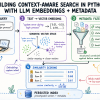
In this article, you will learn how to build a context-aware semantic search engine in Python that combines embedding-based similarity with structured metadata filtering.